
Gym CRM Features: The 15-Point Checklist Every Gym Owner Needs Before Buying

Choosing a gym CRM is one of the highest-leverage decisions you will make for your business. The right platform turns enquiries into members, keeps your front desk accountable, and flags at-risk members before they quietly cancel. The wrong one costs you leads, staff hours, and ultimately revenue. This checklist covers the 15 gym CRM features that separate a genuine growth tool from a glorified contact list, with the exact questions to ask any vendor before you commit.
Why gym CRM features matter more than price
The most important gym CRM features are those that directly touch the two moments where money moves: when a prospect first enquires, and when an existing member decides whether to stay. A platform missing even two or three of the capabilities below will force your team to patch the gaps with spreadsheets, manual texts, or third-party tools that rarely talk to each other cleanly. Before comparing prices, compare capability. A $199/month +GST platform that converts 30 percent more leads is far cheaper than a $99/month tool that lets those leads go cold.
The 15-point gym CRM features checklist
1. Visual lead pipeline
A drag-and-drop pipeline shows every prospect's stage at a glance, from first enquiry to signed member. Without it, leads live in inboxes and sticky notes, and follow-up becomes whoever happens to remember. Ask the vendor: can I customise pipeline stages to match my sales process, and can I filter by source, staff member, or date range?
2. Two-way SMS
Email open rates in fitness hover around 20 to 25 percent. SMS open rates are consistently above 90 percent, and two-way SMS means the prospect can reply and your team sees the conversation in one place. One-way broadcast SMS is not the same thing. Ask the vendor: does the reply come back into the CRM, or does it disappear to a separate number your staff never check?
3. Unified inbox with social DMs
Leads arrive through Facebook ads, Instagram DMs, website forms, and phone calls simultaneously. A unified inbox consolidates all of these into a single view so no enquiry falls through the cracks. Ask the vendor: does the inbox include native Instagram and Facebook DM integration, or does it require a third-party connector that can break when those platforms update their APIs?
4. AI lead scoring
Not every lead deserves the same urgency. AI lead scoring analyses behaviour signals, such as how many messages a prospect has sent, whether they have visited your website multiple times, or how quickly they responded, and ranks leads so your sales team calls the hottest ones first. Ask the vendor: what signals feed the scoring model, and can I see the score alongside each contact without clicking into a separate report?
5. Call and tour logging
If your staff cannot log a phone call or a gym tour against a lead record, you have no audit trail and no way to coach underperforming team members. Call logging with timestamps and outcome notes is a non-negotiable accountability feature. Ask the vendor: can staff log calls and tours from their mobile, and does the log attach to the lead's timeline?
6. Automated follow-up sequences
The average gym needs five to eight touchpoints before a prospect converts. Manual follow-up at that volume is unrealistic. Automated sequences, triggered by a lead's pipeline stage or inactivity period, keep communication consistent without relying on staff memory. Ask the vendor: can I build multi-step sequences that mix SMS, email, and push notifications, and do they pause automatically if the lead replies?
7. By-salesperson reporting
Aggregate conversion data tells you whether the gym is performing. By-rep reporting tells you which staff member is converting at 45 percent and which is converting at 15 percent, so you know where to coach. Ask the vendor: can I filter leads, conversions, and revenue by individual staff member, and is this available to managers without needing a developer to build a custom report?
8. Appointment and tour booking
Frictionless booking is a conversion lever. If a prospect has to call during business hours to schedule a tour, many will not bother. An integrated booking tool lets them pick a time from a live calendar and receive automatic confirmation and reminders. Ask the vendor: does booking sync to staff calendars in real time, and does a no-show or cancellation trigger an automatic follow-up?
9. Data import and migration tools
Switching CRMs is painful if you have to manually re-enter thousands of member records. Look for pre-built import presets for the platforms you are migrating from, whether that is Mindbody, Glofox, Zen Planner, PushPress, Hapana, or a plain CSV export from almost anything else. Ask the vendor: who does the migration work, my team or yours, and is there a data validation step before go-live?
10. Seamless lead-to-member handoff
The moment a lead signs up, their record should become a full member profile with no re-keying. This handoff should carry across their contact details, communication history, digital waivers, and payment method so the member experience starts without friction. Ask the vendor: does the handoff happen automatically on sign-up, and does the member's sales conversation history remain visible to the member-services team?
11. Digital waivers with e-signatures
Paper waivers get lost. Digital waivers with e-signatures are stored against the member's profile with a timestamp, making them retrievable in seconds for compliance purposes. This is particularly important in Australia, where duty-of-care requirements for gym operators are taken seriously. Ask the vendor: are waivers stored on Australian servers, and can I customise the waiver text without needing a developer?
12. AI churn prediction and win-back automation
Keeping a member costs roughly a fifth of acquiring a new one. AI churn prediction identifies members whose visit frequency, class bookings, or engagement has dropped below a threshold that historically precedes cancellation, giving your team a chance to intervene. Ask the vendor: how far in advance does the model flag at-risk members, and can it trigger an automated win-back sequence or does it only create a manual task?
13. NPS surveys and feedback tools
Net Promoter Score surveys sent at the right moment, typically after a member's first month or after a class series, give you structured sentiment data rather than anecdote. Integrated NPS means responses attach to the member record and can trigger follow-up workflows. Ask the vendor: are surveys sent in-platform or via a third-party integration that adds another monthly cost?
14. Role-based staff permissions
A personal trainer should not have access to financial reports. A front-desk team member should not be able to delete member records. Granular, role-based permissions protect data integrity and limit liability. Ask the vendor: how many distinct permission roles exist, and can I customise them, or am I locked into a few preset categories?
15. Reporting depth and revenue forecasting
Lagging indicators like last month's revenue are table stakes. What separates good gym CRM features from great ones is forward-looking reporting, such as revenue forecasting, scenario modelling, and leads-by-source attribution, that helps you make decisions before a problem becomes a crisis. Ask the vendor: does forecasting update automatically from live data, and can I build custom reports without exporting to a spreadsheet every time?
How VERVE Pulse covers the checklist
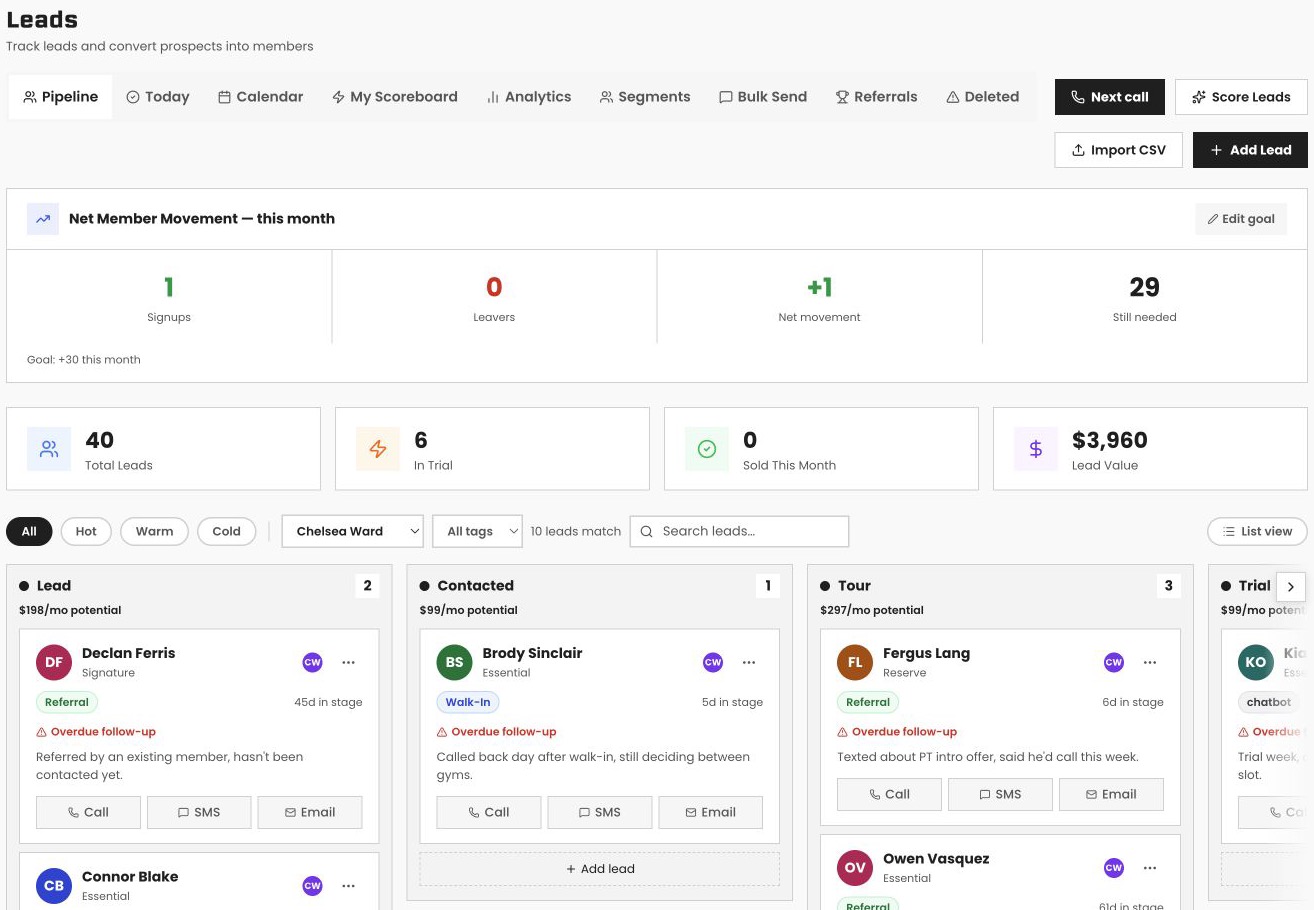
VERVE Pulse is an Australian-built gym CRM and management platform designed specifically for gym owners. Every item on the checklist above is included natively, without third-party patches. The CRM includes a visual lead pipeline, two-way SMS, a unified inbox with Instagram and Facebook DMs, AI lead scoring, call and tour logging, automated follow-up sequences, and by-salesperson reporting. Data import presets cover Mindbody, Glofox, Zen Planner, PushPress, Hapana, and CSV, and white-glove migration is included on annual plans so VERVE's team handles the move for you. Member handoff is automatic, carrying conversation history, digital waivers with e-signatures, and payment details across to a full member profile. AI churn prediction and role-based permissions across seven roles are included on every plan, with NPS surveys on Grow and up and a custom report builder on Pro. For a full feature breakdown, visit the VERVE Pulse features directory.
Plans start at A$166/month +GST (billed annually) (Core), with Grow at $349/month +GST and Pro at $549/month +GST. There are no per-member fees on any plan. Book a free demo to see it live. Annual billing includes two months free. See the full plan breakdown on the pricing page.
Feature comparison: what to look for across platform types
| Gym CRM feature | VERVE Pulse | Typical international platforms |
|---|---|---|
| Visual lead pipeline | Included all plans | Often CRM add-on or separate tier |
| Two-way SMS | Included all plans | Varies by plan or add-on cost |
| Unified inbox (Instagram + Facebook DMs) | Included all plans | Rarely native; often third-party integration |
| AI lead scoring | Included all plans | Uncommon; varies by platform |
| Call and tour logging | Included all plans | Varies; sometimes manual notes only |
| Automated follow-up sequences | Included all plans | Often upper-tier or add-on |
| By-salesperson reporting | Included all plans | Varies by plan |
| Appointment and tour booking | Included all plans | Often separate booking tool |
| Pre-built migration presets | 6 platforms + CSV | Varies; often CSV only |
| AI churn prediction | Included all plans | Uncommon; varies by platform |
| Data residency (Australia) | AWS Sydney | Often US or EU servers |
| Per-member fees | None | Common at scale |
Related resources
- What is a gym CRM? A plain-English explainer
- VERVE Pulse gym CRM product overview
- Best gym CRM systems in Australia compared
- Gym software buyer's guide
- Free gym revenue, churn, and ROI calculators
Frequently Asked Questions
What are the most important gym CRM features for a small gym?
For a small gym, the highest-impact gym CRM features are a visual lead pipeline, two-way SMS, automated follow-up sequences, and by-salesperson reporting. These four cover the full enquiry-to-member journey and ensure no lead is forgotten without needing a large sales team. AI lead scoring and churn prediction add further leverage once your member base grows beyond a few hundred.
Should a gym CRM include member management, or is it just for leads?
A good gym CRM handles both. The lead-to-member handoff should be automatic and seamless, carrying communication history, signed waivers, and billing details into a full member profile without any re-keying. Platforms that treat CRM and member management as completely separate modules often create data silos that make retention reporting unreliable.
How does AI lead scoring work in a gym CRM?
AI lead scoring analyses behavioural signals, such as how quickly a prospect responded to your first message, how many times they have visited your website, and how recently they engaged, and assigns a score that indicates purchase likelihood. Your sales team can then prioritise the highest-scoring leads each morning rather than working through a flat list chronologically. Ask any vendor what specific signals their model uses and whether the score is visible on the main pipeline view.
What should I ask a vendor about data migration when switching gym CRM platforms?
Ask whether they offer pre-built import presets for the platform you are leaving, who performs the migration work (your team or theirs), and whether there is a validation step to catch errors before go-live. If you are migrating from Mindbody, Glofox, Zen Planner, PushPress, or Hapana, look for a platform with native presets for those systems. VERVE Pulse includes white-glove migration concierge on annual plans, meaning VERVE's team handles the member migration for you.
Do I need a separate tool for gym marketing, or should my CRM handle it?
Ideally your gym CRM should handle core marketing functions natively, including email and SMS campaigns, automated drip sequences, and lead source attribution reporting. Using a separate marketing platform creates sync delays and attribution gaps that make it harder to know which campaigns are actually driving sign-ups. Where deeper integrations are needed, look for a CRM with native connections to tools like Google Calendar, Mailchimp, or Xero rather than relying on generic middleware.
Ready to see VERVE Pulse for yourself?
Book a demo and our team will walk you through the CRM, AI lead scoring, and the whole gym platform underneath it, live and tailored to your gym.