
Gym Membership Sales Scripts: A Complete Playbook for Australian Gym Owners
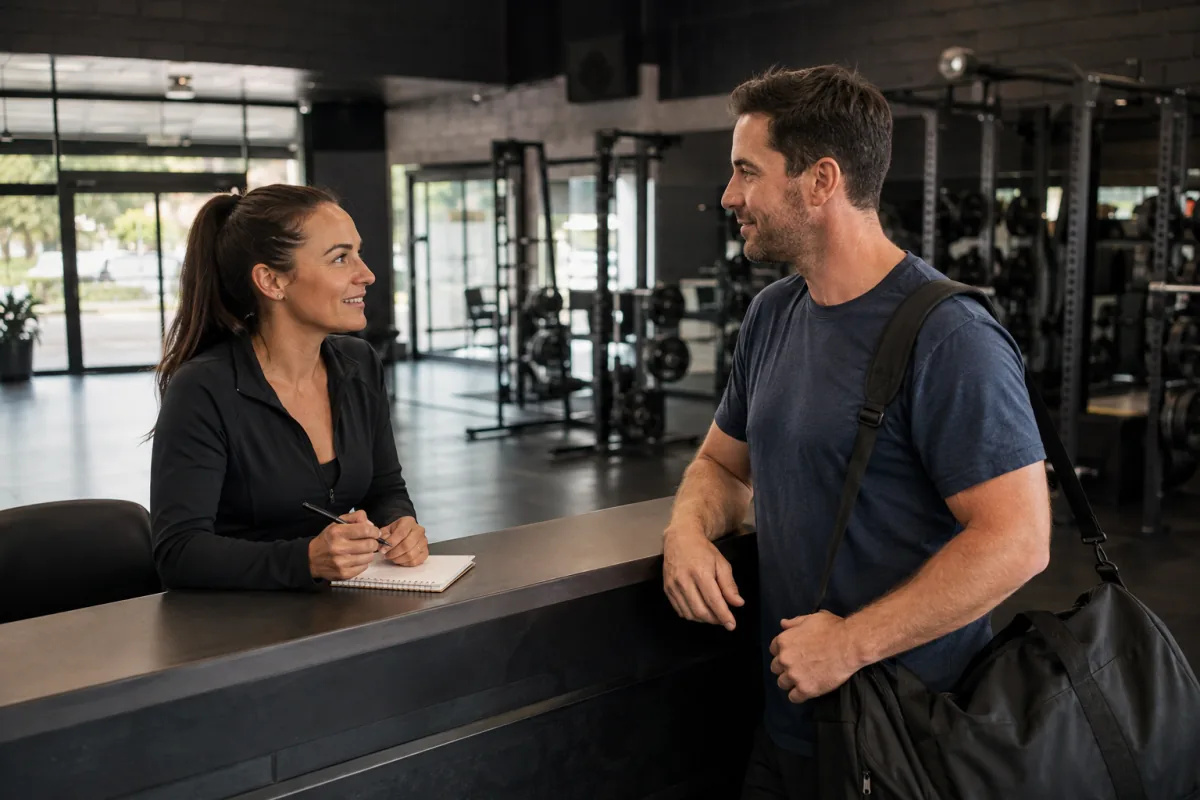
A great gym membership sales script is not a word-for-word recital. It is a flexible conversation framework that helps your team ask the right questions, handle objections confidently, and guide a prospect from curious to committed without ever feeling pushy. The scripts below are built specifically for Australian gym environments, where price sensitivity, long-term contract reluctance, and the casual 'I'll think about it' are your most common friction points.
What makes a gym membership sales script actually work?
A gym membership sales script works when it leads with the prospect's goal, not the gym's features. The best scripts open with an empathy-based question, use the prospect's own words to frame the value of membership, and create a clear, low-pressure next step. Scripts that list facilities first and ask for payment last consistently underperform those that reverse the order.
Before you write a single line, know these four things about your prospect:
- What outcome are they chasing (fat loss, strength, social connection, stress relief)?
- What has stopped them from achieving that outcome before?
- What is their timeline or trigger (wedding, holiday, doctor's advice)?
- Who else is involved in the decision?
Every script stage below is designed to surface those answers naturally.
Stage 1: The inbound enquiry call script
The inbound call script covers the first 90 seconds after a prospect calls or submits a web form. Your only job is to book a tour, not sell a membership over the phone. Keep it warm, keep it brief, and get the appointment locked in.
Opening (15 seconds)
"Hey [Name], it's [Your Name] from [Gym Name], thanks so much for reaching out. I'd love to learn a bit about what you're looking to achieve. Do you have two minutes now?"
Discovery question (30 seconds)
"What's made you start looking at gyms right now?" Then stop talking. Let them answer fully. Reflect back: "So it sounds like [their words]. That's exactly the kind of thing we help people with here."
The pivot to booking
"The best thing I can do for you is get you in for a quick tour so you can see the space and we can put together something that actually fits your life. I've got [Day] at [Time] or [Day] at [Time] available this week. Which works better for you?"
Key rule: Always offer two specific times, never an open-ended "when are you free?" Open questions reduce bookings by giving people too many ways to defer.
Stage 2: The tour and face-to-face consultation script
The in-person consultation is where membership is won or lost. Structure it in three acts: connect, discover, present.
Act 1: Connect (5 minutes)
Welcome them by name, offer water, and reference something from the call. "You mentioned you've tried a couple of gyms before and found the classes didn't fit your work schedule. I kept that in mind when I thought about what to show you today." This signals you listened, and it immediately builds trust.
Act 2: Discover (10 minutes)
Use open questions on the tour itself. Point at the zone relevant to their goal and ask: "What does your current training look like?" and "What's worked for you in the past, even if it didn't stick?" Take mental notes. You will use their exact language in the close.
Act 3: Present (10 minutes)
Sit down. Mirror their language: "Based on what you've told me, [their goal] is the priority. Here's the membership that gives you the best path to that." Present one option first, not three. Decision fatigue kills closes. If they need a different structure, you can flex from there.
Stage 3: Handling the most common objections
Objection handling is not about winning an argument. It is about acknowledging the concern, isolating it, and resolving it with information. Below are scripts for the four objections Australian gym salespeople hear most often.
"It's too expensive"
"I completely understand. Can I ask, when you say it's too expensive, is it the total amount, or is it the weekly cost that's the main concern?" (Wait for the answer.) Then: "If we could get you to [their goal] in [realistic timeframe], what would that be worth to you? Because when you break it down, this membership works out to [weekly equivalent], which is less than a couple of coffees." Anchor to the weekly figure, not the monthly.
"I need to think about it"
"Of course. What is it specifically that you want to think through? Is it the price, the timing, or something else?" This isolates the real objection. If they cannot name one, there is often a hidden concern (partner approval, past failure, fear of commitment) that a gentle follow-up question will surface.
"I'm not ready to commit to a contract"
"That makes total sense. We actually offer a month-to-month option so there's no long-term lock-in. The reason most of our members move to a longer plan down the track is the saving, but there's absolutely no pressure to do that today. Would a no-contract month-to-month feel more comfortable to start?"
"I'll just wait until after [event]"
"I hear that a lot and it makes sense on the surface. But can I share something? Most of our members say the gym actually helped them get through busy periods, not just recover from them. If [event] is in [X] weeks, what if we started you now so you're already in the habit when things settle?"
Stage 4: The close script
The close should feel like the natural end of a conversation, not a pressure moment. Use an assumptive close paired with a low-friction next step.
"Based on everything you've told me, I'd recommend starting on [plan]. To get you set up, all I need is [ID/bank details/email]. The whole process takes about five minutes. Want to get that sorted now so you can jump in this week?"
If they say yes, move immediately to paperwork. If they pause, revisit the unresolved objection from Stage 3 rather than re-presenting the product.
Stage 5: The follow-up sequence (for prospects who don't close on the day)
Most gym leads require three to five touchpoints before converting. A structured follow-up sequence is what separates gyms that grow from gyms that plateau. Here is a simple five-touch framework:
- Same day (SMS): "Great to meet you today, [Name]. Here's a recap of the membership we discussed: [link or summary]. Any questions, just reply to this message."
- Day 2 (email): Send a short story about a member who had a similar goal and outcome. No hard sell.
- Day 4 (SMS): "Hey [Name], just wanted to check in. Are there any questions I can answer for you?"
- Day 7 (call): Ring at a time that suits their profile (evenings for 9-to-5 workers). Reference the original conversation.
- Day 14 (email): A genuine final follow-up. "I don't want to keep pestering you, but I wanted to leave the door open. Whenever you're ready, I'm here."
Consistency in this sequence is almost impossible to sustain manually across a growing lead list. That is where a gym CRM earns its keep: automated sequences fire at the right intervals without your team having to remember who needs what touchpoint today.
How VERVE Pulse supports your sales scripts end to end
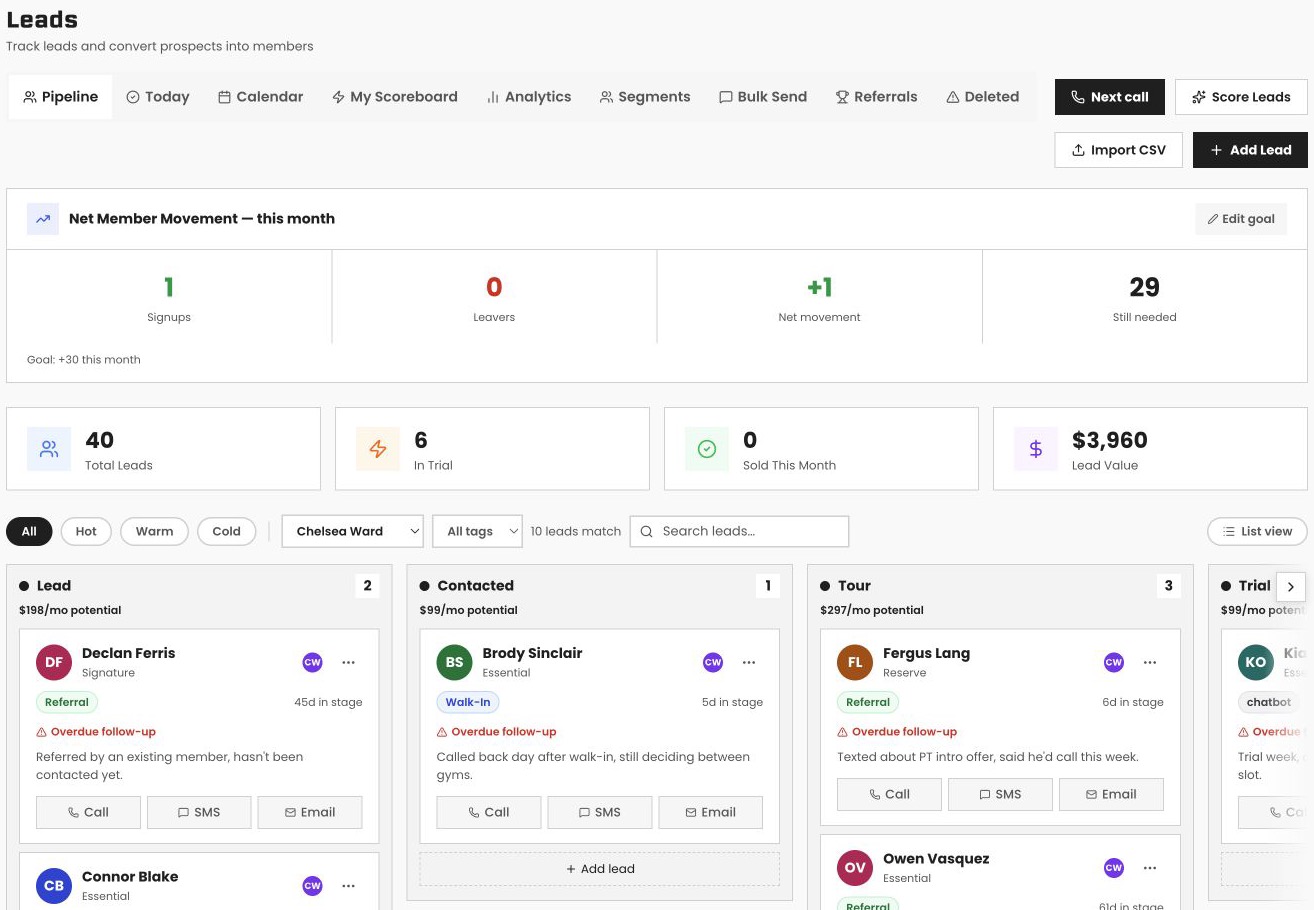
Scripts give your team the words. A gym CRM built for Australian gyms gives your team the system to make those words land consistently, at scale, without anything falling through the cracks.
VERVE Pulse is built around a visual lead pipeline so every prospect sits in the right stage, from first enquiry through to active member. Two-way SMS and a unified inbox that pulls in Instagram and Facebook DMs mean your team responds fast, whatever channel the lead used. AI lead scoring surfaces which prospects are most likely to convert today, so your team prioritises effort on the leads that matter most. Call and tour logging means every touchpoint is recorded, and by-salesperson reporting shows you exactly who on your team is converting and who needs coaching.
Automated follow-up sequences handle the five-touch framework above without manual effort. When a lead goes quiet after a tour, the sequence keeps working in the background. When they reply, it lands in the unified inbox and your team picks it up from there.
| Sales capability | VERVE Pulse | Typical international platforms |
|---|---|---|
| Visual lead pipeline | Included on all plans | Varies by plan or add-on |
| Two-way SMS follow-up | 500 SMS/month included, every plan | Often a paid add-on or usage-based |
| AI lead scoring | Included on all plans | Varies by platform and tier |
| Unified inbox (SMS, Instagram, Facebook DMs) | Included on all plans | Social DMs often excluded or separate |
| Automated follow-up sequences | Included on all plans | Available on most, varies by plan |
| By-salesperson lead reporting | Included on all plans | Varies by platform |
| Australian data residency (AWS Sydney) | Yes | Typically US or EU hosted |
| GST-compliant invoicing | Yes | Not always natively supported |
| Per-member fees | No per-member fees | Common on international platforms |
VERVE Pulse plans start at A$166/month +GST (billed annually) (Core, up to 300 active members), with Grow at $349/month +GST and Pro at $549/month +GST. There are no per-member fees. You can explore everything on the pricing page or check the full features directory to see exactly what is included on each plan. A free, no-obligation demo is available.
If you are migrating from another platform, VERVE Pulse offers white-glove migration concierge on annual plans, with import presets for Mindbody, Glofox, Zen Planner, PushPress, Hapana, and CSV files. The gym software buyer's guide covers what to look for when switching platforms.
Frequently Asked Questions
How long should a gym membership sales script be?
A script should be a framework, not a speech. Your inbound call script should cover 90 seconds. The in-person consultation runs 20 to 30 minutes including the tour. The close itself should take five minutes or less. If you are talking for longer than your prospect, the script needs trimming.
Should gym sales staff memorise scripts word for word?
No. Word-for-word recitation sounds robotic and erodes trust. Train your team on the purpose of each script stage, the key questions to ask, and the language to mirror back. Role-play is the best training method: pair staff and run objection scenarios until the responses feel natural, not rehearsed.
How many follow-up touches does it take to convert a gym lead?
Industry experience across gyms consistently points to three to five touchpoints before a prospect converts. The majority of leads that are followed up only once or twice are lost to a competitor or to inertia. A structured, automated follow-up sequence in a gym CRM removes the human memory problem and keeps every lead in play until they convert or opt out.
What is the single biggest mistake gym owners make with membership sales?
Leading with features instead of the prospect's goal. Listing equipment, class timetables, and amenities before understanding what the prospect actually wants to achieve disconnects the conversation from what matters to them. The most effective scripts spend 60 to 70 percent of the conversation in discovery before presenting any solution.
Can VERVE Pulse automate my gym's follow-up sequences?
Yes. VERVE Pulse includes automated follow-up sequences on all plans, combined with two-way SMS (500 messages per month included), a unified inbox for Instagram and Facebook DMs, and a visual lead pipeline to track each prospect's stage. AI lead scoring also highlights which leads in your pipeline are most likely to convert, so your team focuses energy where it matters most. You can explore all capabilities on the features page or read more about choosing the right system in our gym CRM explainer.
Ready to see VERVE Pulse for yourself?
Book a demo and our team will walk you through the CRM, AI lead scoring, and the whole gym platform underneath it, live and tailored to your gym.