
Gym Sales Pipeline Stages That Turn Enquiries Into Members
What are the stages of a gym sales pipeline?
A gym sales pipeline typically runs through seven stages: New Enquiry, Contacted, Tour Booked, Tour Completed, Offer Made, Joined, and Lost. Each stage represents a distinct commitment level from the prospect, gives your team a clear next action, and lets you measure where leads are advancing, stalling, or dropping out entirely.
Running a gym without a defined pipeline is like coaching a class with no programming. Everyone is busy, but nobody knows whether the effort is producing results. A structured pipeline fixes that by making every lead's status visible, every team member's responsibility explicit, and every conversion gap measurable. Below is a practical stage model you can implement immediately, along with what to track at each step and how a visual pipeline changes the way your sales team behaves day to day.
Stage 1: New Enquiry
A New Enquiry is any lead that has entered your system but has not yet been contacted. The clock starts the moment an enquiry lands, whether it comes from a Facebook ad, an Instagram DM, a walk-in, a referral, or your website contact form. Speed to first contact matters enormously at this stage.
What to track
- Source of the enquiry (paid ad, organic, referral, walk-in)
- Time and date the enquiry arrived
- Any qualifying information already captured (goal, membership type interest)
What the team should do
Assign the lead to a staff member immediately and set an automated follow-up sequence so no enquiry sits untouched. If your system supports AI lead scoring, use that signal to prioritise which new enquiries your top salespeople handle first.
Stage 2: Contacted
A lead moves to Contacted once a genuine two-way exchange has happened, a phone call made, an SMS replied to, or a direct message exchanged. A voicemail or an outbound SMS with no reply does not count; the prospect needs to have acknowledged you.
What to track
- Contact method used (call, SMS, Instagram DM, Facebook DM)
- Number of outreach attempts before contact was made
- Notes on what the prospect said about their goal or timeline
What the team should do
Log call and contact details against the lead record so nothing lives in a salesperson's head or personal phone. The purpose of this stage is a single outcome: book a tour.
Stage 3: Tour Booked
Tour Booked means the prospect has a confirmed appointment to visit your facility. This is a significant commitment signal and is worth tracking separately from simply being in conversation.
What to track
- Tour date and time
- Which staff member is hosting the tour
- Whether a confirmation SMS or email has been sent
- Show rate (what percentage of booked tours actually show up)
What the team should do
Send a confirmation immediately, then a reminder 24 hours before and another one hour before the appointment. Automated reminders reduce no-shows without requiring manual effort from your team. If the prospect no-shows, move them back to Contacted and restart outreach rather than letting them sit in a stale booking stage.
Stage 4: Tour Completed
The prospect came in. This is your highest-leverage moment in the entire pipeline because nothing you say over SMS or email replaces the experience of being inside your gym. A completed tour should always end with an offer on the table, even a preliminary one.
What to track
- Tour completion rate (tours completed divided by tours booked)
- Tour host (so you can compare close rates by staff member)
- Prospect's stated objections or hesitations, logged as notes
- Whether a follow-up appointment was made before they left
What the team should do
Conduct a structured tour, not a wander around the floor. Connect what you show them to what they told you their goal was during the contact stage. Before they leave, make an offer or set a specific follow-up time. A vague 'think it over' ending is where most gym sales die.
Stage 5: Offer Made
An offer has been presented, whether verbally during the tour or in a follow-up message. The prospect is actively considering joining. This stage often has the longest and most variable dwell time in the pipeline.
What to track
- Which membership plan or package was offered
- Any promo codes or incentives applied
- Days the lead has been sitting in this stage
- Number of follow-up touches made since the offer
What the team should do
Set a follow-up cadence and stick to it. One call, one SMS, one email spaced over a few days is a reasonable sequence for a warm prospect. Leads that sit in Offer Made without activity are the most common cause of silent pipeline bloat. A visual pipeline makes these stale leads impossible to ignore.
Stage 6: Joined
The prospect has signed up and is now a member. Their lead record converts to a member profile, and responsibility shifts from sales to retention. The pipeline's job here is to record the win accurately so you can trace it back to its source and to the team member who closed it.
What to track
- Which membership plan they joined on
- Revenue attributed to this lead (for salesperson reporting)
- Days from first enquiry to sign-up (pipeline velocity)
- Lead source, so you know which channels produce members, not just enquiries
Stage 7: Lost (with Reasons)
A lead is marked Lost when they have clearly decided not to join, or when all reasonable follow-up attempts have been exhausted. Capturing loss reasons is not a post-mortem exercise; it is one of the most valuable inputs your sales process has.
Common loss reasons to categorise
- Price or value objection
- Chose a competitor
- Timing not right (moved, injured, financial circumstances)
- No response after multiple attempts
- Location or schedule did not suit
When loss reasons are tagged consistently, patterns emerge. If 'price' spikes in a particular month, your offer or communication may need adjusting. If 'no response' dominates, your follow-up sequences may not be reaching people. Neither insight is visible without structured data.
What to measure across the full pipeline
| Pipeline stage | Key metric | What a problem looks like |
|---|---|---|
| New Enquiry to Contacted | Contact rate and time to first contact | Leads ageing more than 24 hours without contact |
| Contacted to Tour Booked | Booking conversion rate | Low rate may indicate weak offer, wrong audience, or script gaps |
| Tour Booked to Tour Completed | Show rate | High no-show rate signals reminder cadence or booking quality issues |
| Tour Completed to Offer Made | Offer rate | Tours completing without an offer means training is needed |
| Offer Made to Joined | Close rate | Long dwell time or low close rate points to objection-handling gaps |
| Lost leads | Loss reason distribution | One reason dominating signals a systemic issue, not a one-off |
How a visual pipeline changes team behaviour
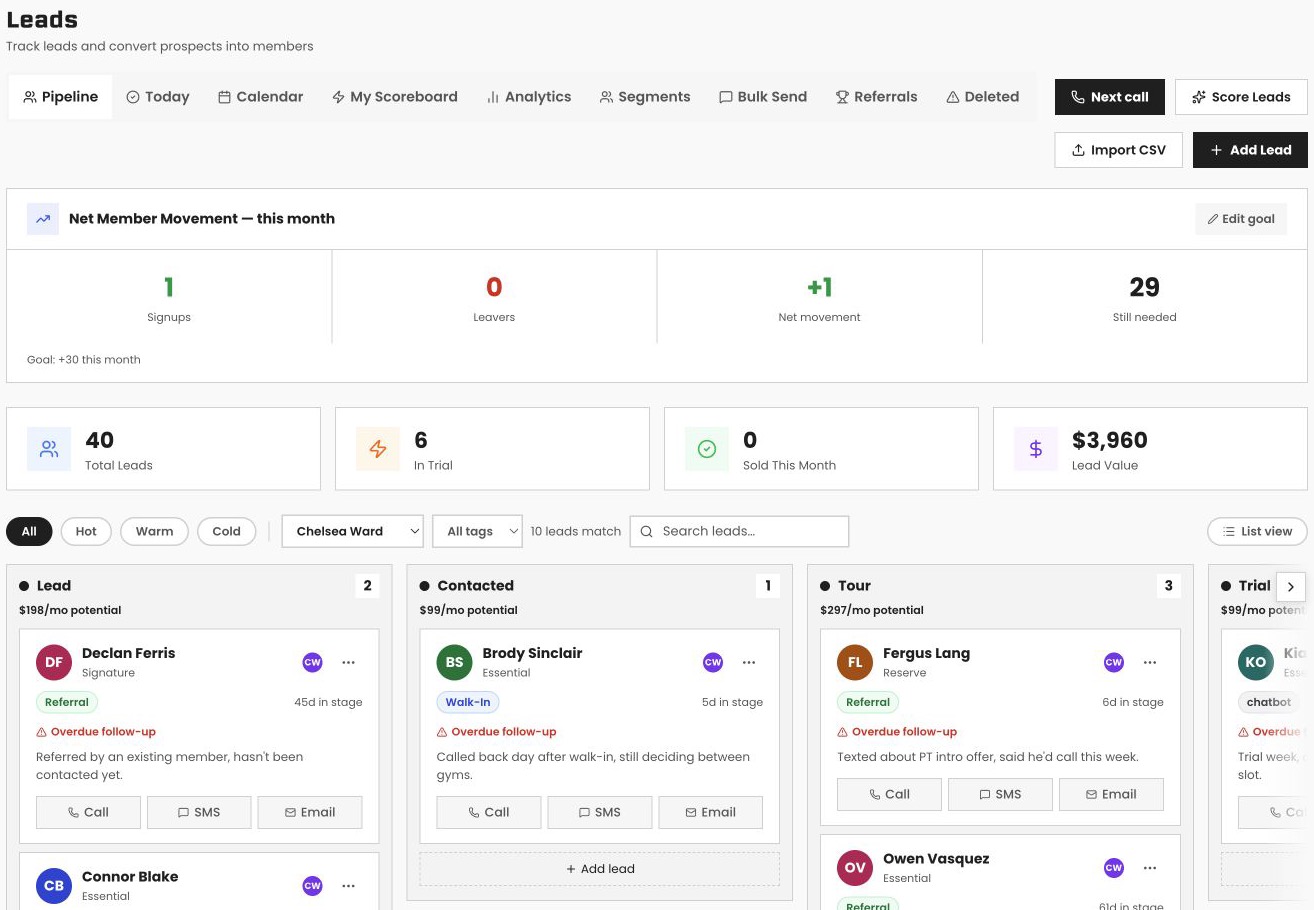
A visual pipeline, where every lead sits in a clearly labelled column that anyone on the team can see, does something a spreadsheet or a mental tally cannot: it makes accountability social. When a salesperson's leads are visible to the whole team and to management, the natural response is to keep them moving.
Specific behaviour changes you should expect once a visual pipeline is in place include:
- Stale leads get attention. When 'Tour Booked' shows leads sitting untouched for five days, the responsible team member knows it, and so does their manager.
- Daily stand-ups become focused. Instead of a general 'how are things going' conversation, the pipeline gives a concrete agenda: what moved yesterday, what is stuck today, what needs escalation.
- Healthy competition between salespeople becomes possible without manufactured pressure, because performance is visible in the same shared view.
- Hand-offs between team members are clean. If a team member is away, anyone can see the status and history of every lead and pick up without a briefing.
The VERVE Pulse gym CRM includes a visual lead pipeline with drag-and-drop stage management, two-way SMS, a unified inbox for Instagram and Facebook DMs, AI lead scoring, automated follow-up sequences, and by-salesperson reporting, so every stage described above has a corresponding tool rather than a manual workaround. You can explore the full feature set at the features directory, or review plan options at the pricing page (Core at $199/month +GST, Grow at $349/month +GST, Pro at $549/month +GST, with no per-member fees and a free, no-obligation demo).
If you want to understand the broader context of how a CRM fits into gym management, the gym CRM explainer is a good starting point, and the gym software buyer's guide covers how to evaluate platforms when you are ready to compare options.
Frequently Asked Questions
How many stages should a gym sales pipeline have?
Seven stages works well for most gyms: New Enquiry, Contacted, Tour Booked, Tour Completed, Offer Made, Joined, and Lost. Fewer stages and you lose visibility into where leads are stalling. More stages and the system becomes cumbersome for staff to maintain. The goal is a stage for every meaningful change in prospect commitment, not a stage for every possible interaction.
What is pipeline velocity and why does it matter for gyms?
Pipeline velocity is the average number of days it takes a lead to travel from New Enquiry to Joined. It matters because a long average velocity means your cash is tied up in slow-moving leads, and it often indicates a specific bottleneck in the pipeline. Tracking velocity by lead source also tells you which channels bring in prospects who are ready to decide quickly versus those who need longer nurturing.
Should lost leads ever come back into the pipeline?
Yes. Leads marked Lost with a timing-based reason, such as injury, financial pressure, or a move that fell through, are strong candidates for a win-back sequence three to six months later. Your CRM should let you tag these leads and trigger an automated re-engagement campaign at the right interval. Do not treat Lost as permanent; treat it as 'not right now' for a meaningful subset of your lost enquiries.
How does AI lead scoring fit into a gym sales pipeline?
AI lead scoring analyses signals in a lead's profile and behaviour, such as how they came in, what information they provided, and how they have engaged with your follow-up, to rank which leads are most likely to convert. In a busy pipeline, this tells your best salespeople where to focus first rather than working leads in the order they arrived. VERVE Pulse includes AI lead scoring as part of its CRM, available on all plans.
How do I know if my gym's close rate is healthy?
Rather than benchmarking against industry averages, which vary widely by location, price point, and lead source, focus on your own trend over time. Set a baseline for your current offer-to-join close rate, then test specific changes (offer structure, follow-up cadence, tour script) and measure whether the rate moves. Consistent internal measurement is more actionable than an external number that may not reflect your market or business model. Use VERVE Pulse's free calculators to model how improvements in close rate affect your overall revenue.
Ready to see VERVE Pulse for yourself?
Book a demo and our team will walk you through the CRM, AI lead scoring, and the whole gym platform underneath it, live and tailored to your gym.